
As organisation are adopting data-driven approach to grow and create value to their business, but the challenges in the traditional methods to get required for analysis takes days and months for business to use the data.
The modern data pipelines make it easy to move data and extract value from it within hours or days. In this article we will cover definitions and examples of data pipelines, must-have features of modern data pipelines.
A data pipeline is a set of tools and processes used to automate the movement and transformation of data between a source system and a target repository.
Source systems often have different methods of processing and storing data than target systems. Therefore, data pipeline software automates the process of extracting data from many disparate source systems, transforming, combining and validating that data, and loading it into the target repository.
Building data pipelines breaks down data silos and creates 360degree view of the business. Business can then apply BI and analytics tools to create data visualisations and dashboards to derive and share actionable insights from the data.
A batch data pipeline periodically transfers bulk data from source to target. For example, the pipeline can run once every twelve hours. Batch pipeline can be organised to run at a specific time daily when there’s low system traffic.
A streaming data pipeline continually flows data from source to target while translating the data into a target format in real-time. This is suitable for data that requires continuous updating. For example, to transfer data collected from a sensor tracking traffic.
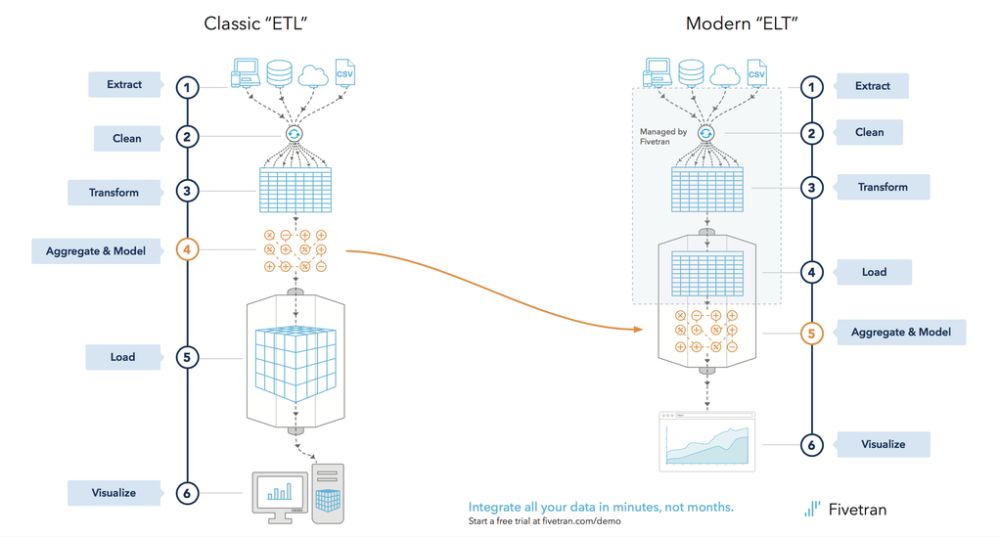
ETL (extract, transform and load) is a data integration process that includes extracting raw data from various data sources, transforming the data on a separate data processing server before loading into the target system such as data warehouse, data mart or a database for analysis or other purposes.
ELT stands for “extract, load, and transform” is the processes a data pipeline uses to replicate data from a source system into a target system such as a cloud data warehouse.
ELT is a modern variation of the older process of extract, transform, and load (ETL), in which transformations take place before the data is loaded.
As mentioned above ETL process requires a separate processing engines for running transformations prior to loading data into a target system. ELT, on the other hand uses the processing engines in the target system to transform data. This removal of an intermediate step helps in streamlining the data loading process.
Since ETL process transforms data prior to the loading stage.

Empowering businesses with scalable technology solutions, expert consulting, and continuous support for digital transformation success.
We use cookies to improve your experience on our site. By using our site, you consent to cookies.
Websites store cookies to enhance functionality and personalise your experience. You can manage your preferences, but blocking some cookies may impact site performance and services.
Essential cookies enable basic functions and are necessary for the proper function of the website.